
We run a day spa. So take this as the honest version rather than the one that tries to talk you out of your own bathroom.
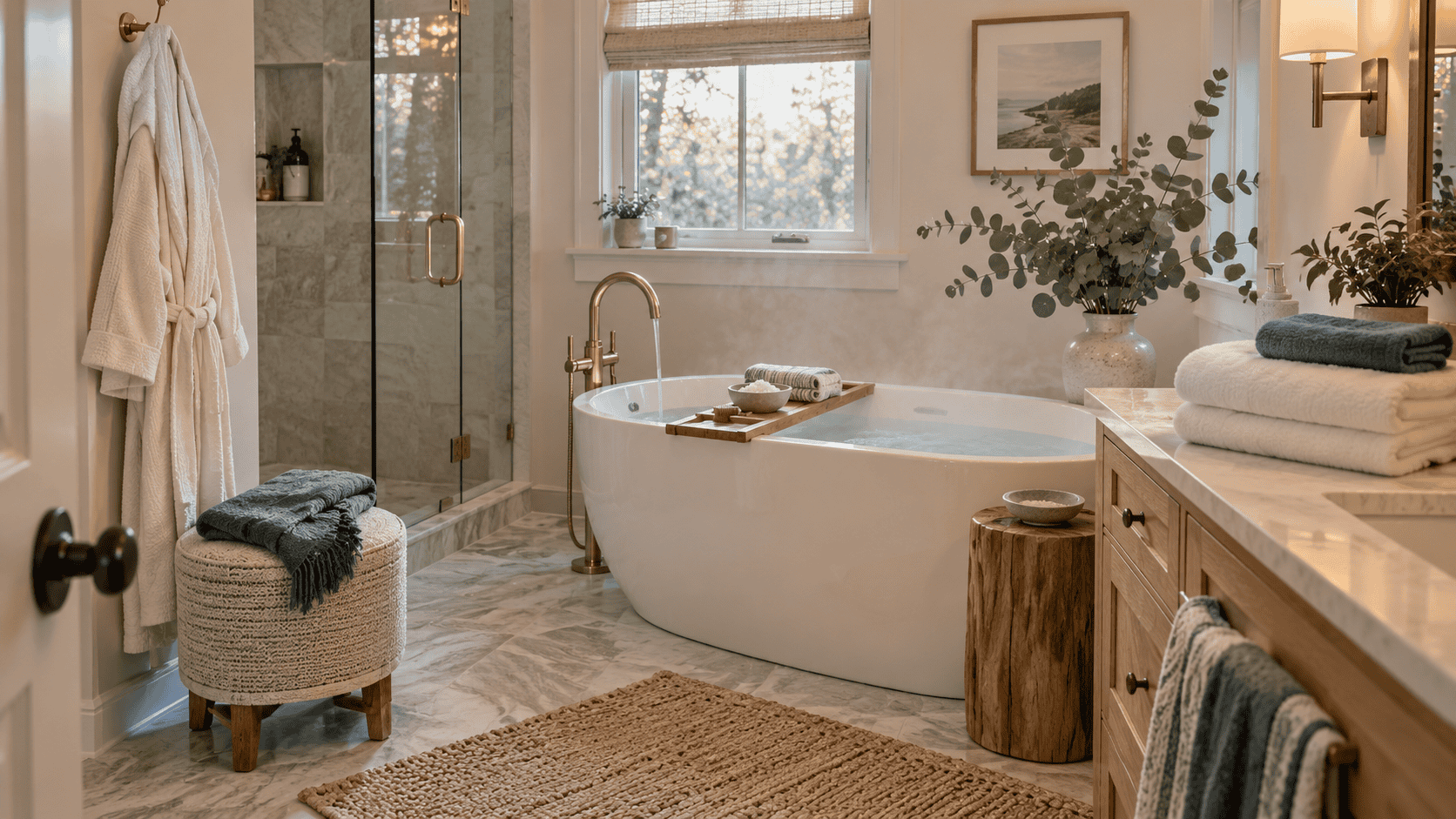
Creating a Spa Experience at Home: What Transfers and What Doesn’t
Some of it moves across almost perfectly and costs nothing. Some of it does not move at all, and no amount of equipment changes that.
By Island Salt & Spa · 10 min read
Most articles on this subject are written to sell you equipment. This one is written by people who do this professionally, which means we know exactly which parts of it you can do yourself.
Here is the useful frame. What makes a spa feel like a spa is not the products, the towels, or the lighting. It is the combination of three things: a room with nothing in it that belongs to your life, a block of time nobody can interrupt, and somebody else taking responsibility for what happens next.
Two of those three you can build at home for free. The third you cannot, and being clear about that is more useful than another list of candles.
The frame
What actually creates the effect
Walk into any spa and the change you feel in the first ninety seconds has almost nothing to do with the treatment menu. It is that the room contains no laundry, no dishes, no post, and no reminder of anything you were supposed to do today.
That is the hardest part to reproduce in a house you live in. Your bathroom contains your toothbrush, someone’s towel on the floor, and a shelf of things you have been meaning to throw out. The room is not neutral, and no candle makes it neutral.
The second element is uninterrupted time. Not time when you happen to be free, but time nobody can reach you. A spa enforces this by taking your phone and putting you in a room. At home you have to enforce it yourself, which is harder than it sounds and more important than everything else on this page.
You are not paying a spa for the oil. You are paying for a room that owes you nothing and an hour where deciding what happens next is somebody else’s job.
Card by card
Eight things, and whether they travel
Tap any card for the honest answer, including how to do it properly where it is worth doing.
The steam on the scent card works best when it can reach the whole room. If you are remodeling anyway, building a curbless shower takes away the curb that holds steam inside a stall, and the floor needs less tilt than most people expect: the International Residential Code, section P2709.1, asks for a slope of a quarter inch to a half inch per foot toward the drain.
Start here
The three cheapest changes that work
If you do nothing else from this page, do these. None of them requires buying anything.
Put the phone in another room
Not silenced, not face down. In a different room with the door closed. Every other item on this list is decoration compared with this one, and it is the only one that is genuinely free.
Kill the overhead light
One low, warm light source. Your bathroom’s ceiling light is designed for shaving and finding things, and it signals alertness to your nervous system for exactly that reason.
Clear every surface first
Ten minutes before you start, take everything off the counter that is not part of what you are about to do. A visually quiet room is the closest you will get to the feeling of a room that owes you nothing.
Safety
DIY treatments worth the caution
Most home spa articles recommend kitchen ingredients without mentioning that some of them are a poor idea on your face. A few things worth knowing before you follow a recipe you found somewhere.
Common home skincare mistakes
- Lemon juice on skin. It is highly acidic and causes photosensitivity, meaning sun exposure afterward can burn or leave lasting pigmentation
- Baking soda as an exfoliant. Far too alkaline for skin and it damages the barrier
- Undiluted essential oils on skin. Always dilute in a carrier oil, and patch test first
- Citrus oils before sun exposure. Bergamot and similar oils are phototoxic
- Steaming for too long. Five to seven minutes is plenty. Longer irritates rather than helps
- Attempting your own extractions. This is how a spot becomes a scar
- Physical scrubs on active acne. Spreading bacteria across inflamed skin makes it worse
- Stacking actives you bought separately without knowing how they interact
None of this means avoid home skincare. Cleanse, hydrate, use a mask, wear sunscreen, and be consistent. That basic routine done weekly beats an elaborate one done occasionally, and it will not damage anything.
If you have a skin concern you are actually trying to solve rather than just a wish to feel looked after, that is the point at which a professional facial earns its cost. An esthetician assesses what your skin is doing before choosing what to put on it, which is the part no recipe can do.
Shoulders you cannot reach, or skin you have been guessing at? That is the part we do.
Ninety minutes
A home routine that actually works
Ninety minutes, no equipment beyond what you own. The order matters for the same reasons it matters in a spa.
Clear the room and warm the towels first, then put your phone somewhere else. Turn off the overhead light. Start with a warm shower or bath rather than jumping into treatments, because a warm body takes everything afterward better than a cold one. Fifteen minutes, no rushing.
Then a mask while you sit rather than while you tidy up. This is the part people compress and it is the part that does the work. Twenty minutes of doing nothing with something on your face is closer to a spa than any product you could buy.
Rinse, moisturize, then spend ten minutes on your feet and hands with any oil you have. Feet in particular are worth the time and almost nobody bothers. Finish by staying in the warm room for a few minutes instead of walking straight back into the house.
That is the whole thing. The parts that cost money are optional. The parts that work are the phone, the light, and not rushing.
Book or skip
When it is worth booking instead
Being straight about it, since we would rather you come in for the right reason than the wrong one.
Book when the problem is physical and specific. Persistent shoulder or back tension is the clearest case, because it is the one area you genuinely cannot reach, and a deep tissue session does in an hour what months of stretching will not. Book when your skin has a problem you have been guessing at. Book when what you need is respiratory rather than cosmetic, since the salt room has no home equivalent at all.
And book when the thing you actually need is to not be in charge for two hours. That is a legitimate reason and it is the one people apologize for most.
Do it at home for everything else. Weekly maintenance, winding down on a Sunday, the small rituals that keep you level. That is not a compromise, it is what home routines are good at. Our guide to planning a spa day covers the sequencing if you decide to book something, and it applies at home too.
Questions
Common questions
No. A salt lamp is a light source made of salt. It emits a warm glow and it looks nice. It does not put respirable salt particles into the air.
Halotherapy needs a halogenerator producing particles fine enough to reach your airways, in a dry climate-controlled room. There is no home version, at any budget.
A dimmer switch or one warm lamp, if you must buy something. Lighting changes a room more than any product in it.
Though the honest answer is that the three most effective changes are free: phone elsewhere, overhead light off, surfaces clear.
You can do the cleansing, masking, and hydrating parts well, and doing them weekly is genuinely worthwhile.
What you cannot do is assess your own skin objectively, perform safe extractions, or use professional-strength actives. If you are treating a concern rather than maintaining, that is where a professional facial is worth the money.
Depends entirely on whether you will use it. Most of these devices deliver a weaker version of a professional treatment and require consistency over months to show anything.
Before spending several hundred dollars, ask honestly whether you will still be using it in twelve weeks. The number of unused facial devices in bathroom cupboards suggests most people should answer no.
Weekly is realistic and enough. Elaborate monthly sessions get skipped, while a simple ninety minutes on a Sunday tends to stick.
Consistency beats production value here, exactly as it does with exercise.
Yes, and taking turns on hands, feet, and shoulders works well. Keep pressure light, avoid the spine directly, and stop if anything hurts.
The limitation is that one of you is always working. If the point is that neither of you is in charge, that is the one thing a home version cannot give you, and it is what a couples booking is actually for.
Sayville
Where our clients come from
We are on Main Street in Sayville, an easy drive from most of the South Shore.
Keep the home routine. Book the rest.
Do the weekly maintenance yourself. Come to us for the shoulders you cannot reach and the room you cannot build.
General wellness information, not medical or dermatological advice. Patch test any new product or ingredient before applying it more widely, dilute essential oils in a carrier oil, and stop immediately if you experience irritation. Speak with a physician or dermatologist about any persistent skin condition, and before heat or bath treatments if you are pregnant or managing a cardiac or circulatory condition. Questions are welcome through our contact page or at 631-510-4073. Island Salt & Spa, 55 Main Street, Sayville, NY 11782.